- 01Key Takeaways
- 02Myth 1: Jack the Ripper Killed Eleven Women
- 03Myth 2: The Name "Jack the Ripper" Came from the Killer
- 04Myth 3: Jack the Ripper Was a Doctor or Surgeon
- 05Myth 4: The Royal Conspiracy
- 06Myth 5: Jack the Ripper Wore a Top Hat and Cape
- 07Myth 6: The Police Investigation Was Incompetent
- 08Myth 7: All Five Victims Were Prostitutes
- 09Myth 8: The Ripper Sent Body Parts to Police
- 10Myth 9: The Murders Stopped Because the Ripper Died
- 11What We Actually Know
- 12What's the best way to separate the real history of the case from the myths?
The Jack the Ripper case is one of history's most distorted criminal investigations. More than 130 years of sensational journalism, conspiracy theories, fictional dramatisations and outright hoaxes have blurred the line between documented fact and popular mythology to the point where most people's understanding of the case is built largely on things that are not true. This guide addresses the most persistent myths directly, explaining what the evidence actually shows and why these stories took hold.
For the underlying history, our Jack the Ripper Timeline covers the canonical murders in order, our suspects guide examines the leading theories, and our victims guide tells the stories of the five women themselves.
Myth 1: Jack the Ripper Killed Eleven Women
The myth: Multiple sources cite eleven victims between 1888 and 1891.
The facts: The Metropolitan Police investigation file covered eleven murders across that period, but the leading investigators themselves drew a clear distinction within it. Sir Melville Macnaghten, Assistant Chief Constable, stated explicitly that the killer had five victims and five only. These canonical five - Mary Ann Nichols, Annie Chapman, Elizabeth Stride, Catherine Eddowes and Mary Jane Kelly - are linked by consistent method: all murdered between August 31 and November 9, 1888, all with throats cut, all showing escalating abdominal mutilations. The remaining six cases in the file involved either different perpetrators or lacked the signature characteristics. Sensational reporting has always preferred the larger number.
Myth 2: The Name "Jack the Ripper" Came from the Killer
The myth: The killer named himself in letters to police and newspapers.
The facts: The name first appeared in the "Dear Boss" letter received by the Central News Agency on September 27, 1888 - and it was almost certainly a journalistic hoax designed to sell newspapers. In Victorian slang, "Jack" simply meant an anonymous common man, the equivalent of "John Doe." Hundreds of letters claiming Ripper authorship arrived at newspapers and police; the vast majority were hoaxes. Whether any letter was actually written by the killer remains unknown. The name was invented by the press and amplified by the press. The killer, whoever he was, almost certainly never called himself that.
Myth 3: Jack the Ripper Was a Doctor or Surgeon
The myth: The medical precision of the killings indicated the killer had professional anatomical knowledge.
The facts: Dr Thomas Bond, who examined victim Mary Jane Kelly and reviewed earlier case evidence, concluded specifically that the killer possessed no special anatomical knowledge and that the injuries were brutal, frenzied and unskilled. The surgeon theory likely emerged from Victorian class prejudice - the assumption that only an educated gentleman could commit such crimes, because the idea of an ordinary person from the East End was too uncomfortable. Modern forensic understanding supports Bond's assessment, not the surgeon myth.
Myth 4: The Royal Conspiracy
The myth: Prince Albert Victor committed the murders, or that a royal physician killed the victims to protect a secret royal marriage.
The facts: Stephen Knight's 1976 book "Jack the Ripper: The Final Solution" popularised this theory. The primary source - a man named Joseph Gorman, who claimed to be Walter Sickert's son - later admitted his story was fabricated. Multiple internal contradictions make the theory untenable regardless: Prince Albert Victor appears to have been homosexual with no interest in the women described; Sir William Gull was 72 years old and recovering from a stroke that had left him partially paralysed; historical records show the prince was likely nowhere near Whitechapel during the murders. The royal conspiracy is popular culture, not history.
Myth 5: Jack the Ripper Wore a Top Hat and Cape
The myth: The killer was a wealthy gentleman in formal evening wear, carrying a black medical bag.
The facts: No historical evidence supports this image at all. Witness descriptions at the time varied widely; none mentioned a cape or top hat. Victorian illustrators created the visual shorthand, and twentieth-century films made it permanent. Such formal attire would have drawn immediate attention in Whitechapel in 1888, then one of the most impoverished districts in Britain. The image has zero historical basis and exists entirely as a visual convention invented after the fact.
Myth 6: The Police Investigation Was Incompetent
The myth: Scotland Yard bungled the investigation through incompetence and refused to adopt modern methods.
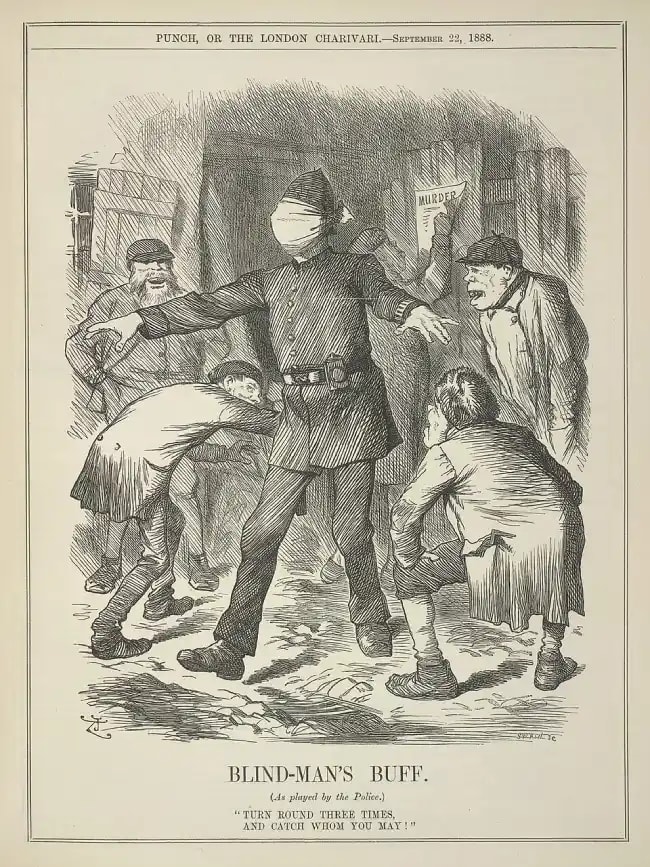
The facts: Victorian police lacked modern forensic tools - no fingerprinting in everyday use, no DNA analysis, no CCTV, no criminal databases. Despite these limitations, the investigation was one of the largest of the nineteenth century. Over 2,000 interviews were conducted, more than 300 investigations pursued, and approximately 80 people detained. Chief Inspector Frederick Abberline demonstrated deep knowledge of Whitechapel's criminal networks. The problem was technological limitation, not incompetence. Arthur Conan Doyle's Sherlock Holmes had created a public expectation that real detectives could not match, and newspapers were happy to frame any failure to solve the case as police inadequacy.
Myth 7: All Five Victims Were Prostitutes
The myth: The canonical five were all full-time professional sex workers.
The facts: Victorian newspapers assumed this based on poverty and late-night street presence. Modern historical research finds no solid evidence that Mary Ann Nichols, Annie Chapman or Catherine Eddowes worked as professional prostitutes. While all five lived in extreme poverty and may at times have exchanged sex for money as a survival strategy, the label reflects Victorian moral judgement far more than historical evidence. Our victims guide tells each woman's story individually and treats the assumption with the scepticism it deserves.
Myth 8: The Ripper Sent Body Parts to Police
The myth: The killer sent a victim's organs to taunt investigators.
The facts: One letter, known as the "From Hell" letter sent to George Lusk of the Whitechapel Vigilance Committee, did arrive with half a preserved kidney. It could not be definitively linked to Catherine Eddowes, who had been missing a kidney. No other body parts were ever sent. Hundreds of other letters claiming Ripper authorship were straightforward hoaxes. The "From Hell" letter has been widely reproduced in books and films, giving it far more prominence than its uncertain status warrants.
Myth 9: The Murders Stopped Because the Ripper Died
The myth: The killings ended in November 1888 because the killer died, drowned in the Thames, was imprisoned or entered an asylum.
The facts: No one knows why the murders stopped. All of those explanations are possible. None has been verified. Without identifying the killer, the reason for the sudden end remains as unknowable as everything else about him. The "he died" narrative provides neat resolution to a case that has none.
What We Actually Know
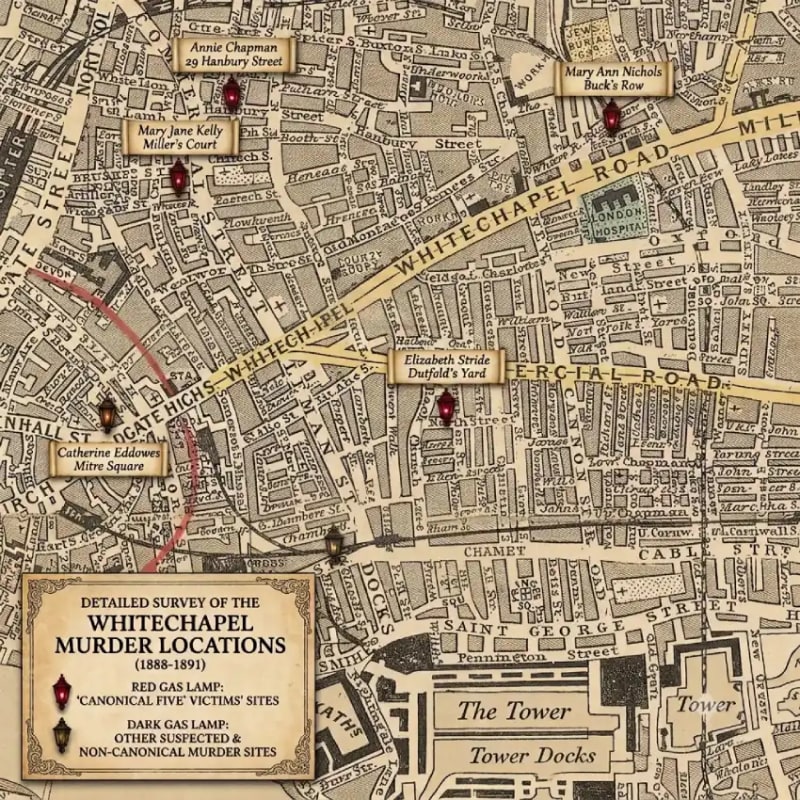
Certain facts about the case are established. Five women were murdered in Whitechapel between August 31 and November 9, 1888. All had their throats cut and suffered abdominal mutilations. The killer was never identified, arrested or prosecuted. The police investigation was extensive given nineteenth-century constraints. Most "evidence" cited in popular books and films is speculative, second-hand or invented. The unsolved nature of the case is precisely what allows myths to keep growing.
What's the best way to separate the real history of the case from the myths?
Walking the streets where the murders occurred is one of the most effective ways to strip away the mythology. The geography is real, the distances are short, and the reality of Victorian Whitechapel is easier to grasp when you are standing in it. Our Jack the Ripper Free Walking Tour covers the evidence alongside the myths - and explains why the case still fascinates, stripped of the fiction.
No credible evidence supports this. Dr Thomas Bond, who examined the case, concluded the killer lacked anatomical knowledge. The theory emerged from Victorian class assumptions, not forensic evidence.
No. Modern historical research finds no solid evidence that all five women were professional sex workers. The assumption originated with Victorian newspapers and reflects the moral judgements of the time rather than fact.
The case has been unsolved for over 130 years, which creates space for speculation. Sensational journalism, conspiracy theories and fictional dramatisations have distorted it further. The gap between what is known and what makes a good story has always been wide.