- 01Key Takeaways
- 02Who Are the King's Guard?
- 03The Ceremonies: What Is Actually On and When
- Main Guard Change
- Captain's Inspection
- Sunday Parade
- 04Why Most Visitors Get the Changing of the Guard London Wrong
- 05The Best Place to See the Changing of the Guard London
- 06What the Complete Self-Guided Route Covers
- 07Before You Go: Practical Tips
- 08What is the best free moment of the Changing of the Guard morning, and where should you stand for it?
The Changing of the Guard London is one of the most recognisable ceremonies in the world. It is also one of the most commonly misunderstood mornings a visitor to London can have.
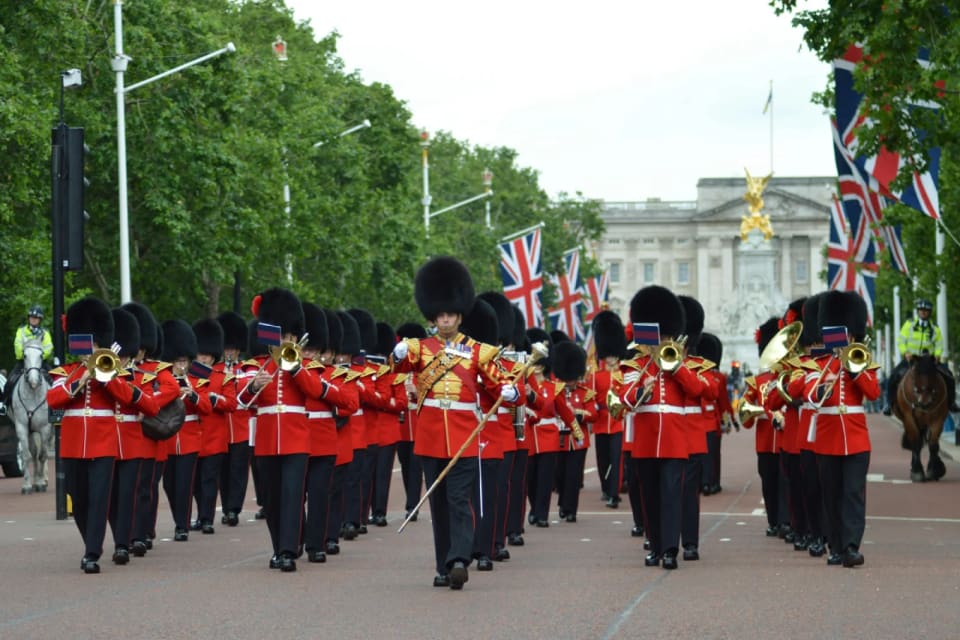
Most people leave a little disappointed. Not because the ceremony is not spectacular - it genuinely is - but because they spent two hours pressed against iron railings at Buckingham Palace, watching the tops of bearskin hats move across a forecourt they could not see into.
The ceremony covers five distinct locations. It includes two separate processions, a regimental band, the King's Life Guard on horseback, and a final handover at St James's Palace where there are no barriers, no crowds, and nothing between you and the soldiers.
Most visitors never see any of it. They do not know it exists.
This guide covers the best place to see the Changing of the Guard London, the key ceremonies across the week, and the one viewing spot that changes everything. If you want the complete picture - every stop, exact timings, and a Google Maps route built on years of running tours along this route - that is what the self-guided guide is for.
Six stops, exact timings, and a numbered Google Maps route - the complete Changing of the Guard morning. A one-time £6.95.
| Ceremony | Days | Time | Details |
|---|---|---|---|
| Main Guard Change | Mondays, Wednesdays, and Fridays | 11:00am | regimental band, marching soldiers, formal handover of the palace keys |
| Captain's Inspection | Tuesdays, Thursdays, and Saturdays | 3:00pm | Smaller, quieter, no band |
| Sunday Parade | Sunday | 10:00am | Noticeably quieter |
| Dismount Parade | daily | 4pm | a daily inspection at Horse Guards that almost no guidebook mentions |
Who Are the King's Guard?
Before you watch the ceremony, it helps to know who you are actually looking at.
Every soldier in those scarlet tunics and bearskin hats is an active member of the British Army. These are not actors performing for tourists. They carry loaded weapons, rotate between ceremonial duties in London and operational deployments abroad, and take the job entirely seriously.
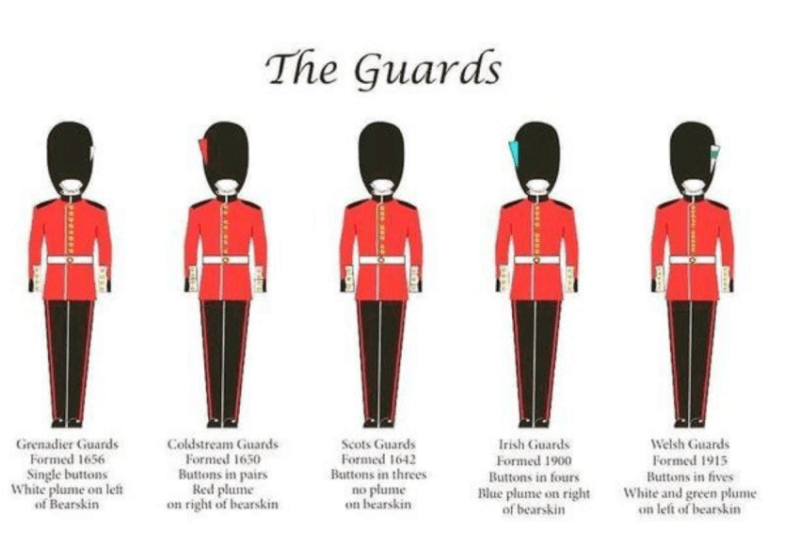
The King's Guard is made up of five regiments of Foot Guards. Once you know what to look for, identifying each regiment as they march past becomes one of the best parts of the experience.
The quickest method is the buttons. Grenadier Guards wear them singly. Coldstream Guards in pairs. Scots Guards in threes. Irish Guards in fours. Welsh Guards in fives. Check the plumes too - but from a distance on a busy morning, buttons never lie.
The Ceremonies: What Is Actually On and When
The Changing of the Guard London is not one single event on one fixed schedule. There are three distinct public ceremonies across the week, each with its own character.
Main Guard Change
Takes place on Mondays, Wednesdays, and Fridays at 11:00am, with troop movements beginning from around 10:30am. This is the full ceremony - regimental band, marching soldiers, formal handover of the palace keys. It covers multiple locations and lasts around an hour from first movement to last.
Captain's Inspection
Tuesdays, Thursdays, and Saturdays at 3:00pm. Smaller, quieter, no band. Minimal crowds and a calmer atmosphere than the weekday ceremony. Worth knowing about if the main ceremony schedule does not fit your plans.
Sunday Parade
The least well-known of the three and, for that reason, worth knowing about. It starts at 10:00am and follows a different sequence to the weekday ceremony. Noticeably quieter. If you have any flexibility, Sunday is often the best day to attend.
Always confirm on the official Household Division calendar before you go. The ceremony cancels at short notice for weather and state occasions.
Why Most Visitors Get the Changing of the Guard London Wrong
The default move is to head straight to the gates of Buckingham Palace and wait.
It seems logical. It is the palace. The ceremony is called the Changing of the Guard at Buckingham Palace. So that is where you go.
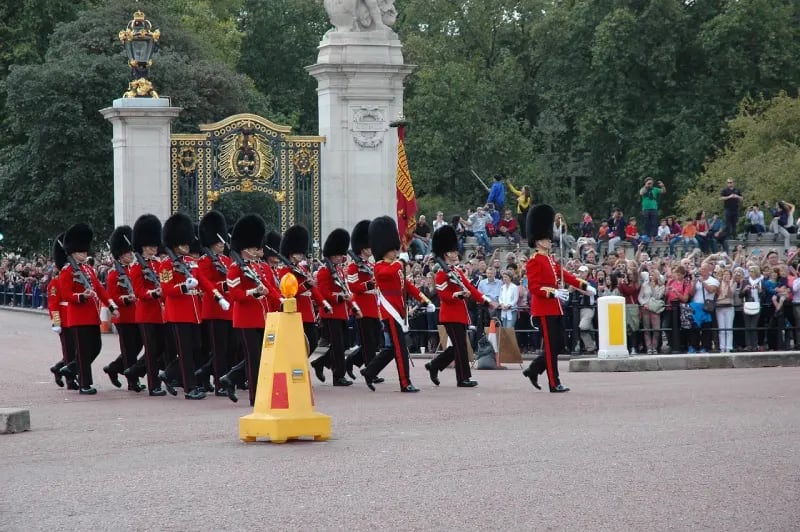
The problem is that what happens behind those gates is the most static and visually restricted part of the entire morning. The handover, the key exchange, the formation work - all of it takes place behind iron railings, at a distance, with hundreds of people packed in front of you.
To hold a decent spot at the gates in peak season you need to arrive very early, often before 10:00am. Once there, you cannot move without losing your position. You will watch bearskin hats in the middle distance and hear a band you cannot quite see.
Meanwhile, the parts that feel genuinely spectacular are happening in open street. The marching. The music at close range. The sound of boots on the pavement as a regiment turns the corner in front of you. Most of the people at the palace gates miss all of it.
The Changing of the Guard London rewards visitors who know where to be and when to move. Standing in one spot for two hours is not the answer.
The Best Place to See the Changing of the Guard London
Here is the London Insiders answer: the best place to see the Changing of the Guard London is not outside Buckingham Palace.
It is at St James's Palace.
At around 11:35am, position yourself on the pavement opposite St James's Palace, near the black statue of Queen Alexandra. Do not stand against the palace railings - the pavement directly opposite gives you the cleaner view and the better photographs.
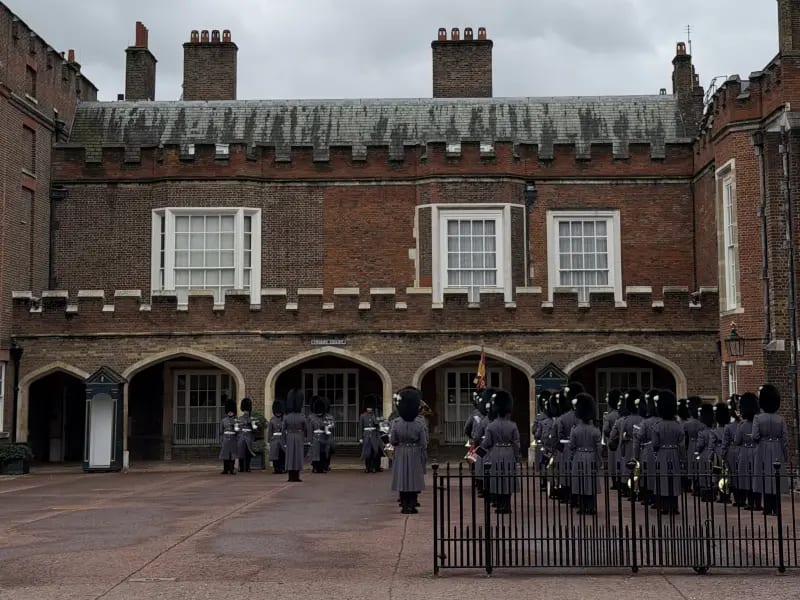
At around 11:43–11:45am, the St James's Palace detachment of the New Guard arrives from Buckingham Palace, led by the regimental band. This is the final movement of the entire ceremony, and it happens in open street.
No railings. No barriers. No crowd ten deep in front of you.
The soldiers march towards you with the band playing, then line up and carry out the handover right in front of the palace. You can hear the commands. You can see the faces. You can take photographs without fighting for a gap between phone screens.
It is the best free moment of the entire morning - and almost nobody is there.
Watch the bearskin plumes as the regiment approaches to identify which regiment is on duty that day. Stand on the pavement directly opposite - the detachment comes from Marlborough Road and you want to see them arriving.
This is one stop. There are five more before it - each with its own timing, its own viewing position, and its own moment worth being there for.
The complete route covers every stop from Wellington Barracks to Horse Guards - with exact timings and where to stand at each one.
See the Full Route →What the Complete Self-Guided Route Covers
The Changing of the Guard London ceremony starts nearly an hour before most visitors at Buckingham Palace see anything at all.
The complete self-guided guide covers the full morning from first movement to last: six stops, exact arrival times, where to stand at each location, photo tips, and a numbered Google Maps route you follow on your phone as the ceremony unfolds.
It includes the inspection of the Old Guard at Friary Court - the official start of the ceremony, in a Tudor courtyard most visitors walk straight past. The New Guard assembling at Wellington Barracks. The procession along The Mall. The Clarence House detachment, a small, almost entirely crowd-free guard change that happens in parallel. And the Household Cavalry at Horse Guards Parade - one of the most underrated free experiences in London, with far smaller crowds than Buckingham Palace and nothing between you and the horses.
It also covers the 4pm Dismount Parade - a daily inspection at Horse Guards that almost no guidebook mentions, where you can stand feet from the horses in an empty courtyard.
Guided tours for the Changing of the Guard ceremony start at around £18–£20 per person. The self-guided route gives you the same insider knowledge, on your own schedule, at whatever time suits your morning. No group. No fixed start point. No waiting for stragglers.
Access is a one-time £6.95. Once unlocked, the guide opens instantly in your browser - no app, no account, no login. It works offline once opened, which matters when signal is patchy around the Palace.
The same insider knowledge as a guided tour, on your own schedule. No group, no fixed start point, no waiting for stragglers. Just £6.95.
Unlock the Changing of the Guard Guide →Before You Go: Practical Tips
A few things worth knowing before the morning.
Check the schedule on the day. The Changing of the Guard London cancels at short notice. Heavy rain is the most common reason. Check the official Household Division calendar before you leave - it takes ten seconds and saves a wasted trip.
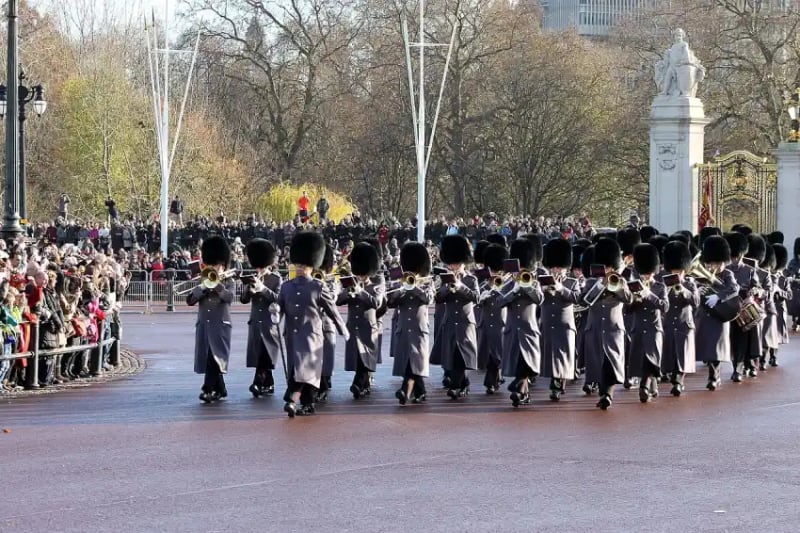
Uniforms change by season. In warmer months you will see the scarlet tunics and bearskin hats. From roughly November onwards the guards may wear long grey greatcoats. If the iconic uniform matters for photographs, late spring through early autumn is the safer bet.
Getting there. For Buckingham Palace and St James's Palace, Green Park (Jubilee, Victoria, Piccadilly) and St James's Park (District, Circle) are both around 8–10 minutes on foot. For Horse Guards Parade, Charing Cross (Bakerloo, Northern) is about five minutes. Avoid driving - roads around the Palace often close before and during the ceremony.
What is the best free moment of the Changing of the Guard morning, and where should you stand for it?
The Changing of the Guard London rewards visitors who know where to be before the ceremony begins - not those who arrive at the palace gates and wait.
St James's Palace at 11:35am is the best free moment of the morning. The complete self-guided route shows you everything that happens before it.
You can also experience the ceremony in context on our Westminster Free Walking Tour, where a guide who has watched this ceremony hundreds of times walks you through the history, the route, and the royal landmarks surrounding it.
Prefer to see it with a local? Our free Westminster & Royal London walking tour ends at the gates of Buckingham Palace - the ceremony, the route, and the stories behind it, told by a guide who has walked it hundreds of times. Free, tip what you like.
See the Westminster Free Walking Tour →Check the exact days and times first in our Changing of the Guard schedule.