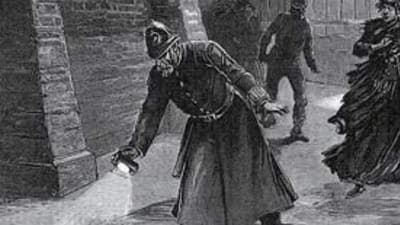
Scotland Yard's own file on the Whitechapel murders ran to more than 100 names by the time the investigation stalled. Most were dismissed within days. When people ask about Jack the Ripper suspects today, they usually mean a much shorter list: the handful of men senior police officers, private investigators, and later researchers actually built a case against. This guide covers all eight, in the order the evidence for each one holds up, from a barrister who drowned himself in the Thames weeks after the final murder to a Polish immigrant a senior detective named by name thirty years later.
None of these men was ever charged. That fact matters more than any theory built since. Whitechapel in 1888 was one of the most deprived districts in the country, and every one of the five canonical victims was living in poverty at the time of her death. The full sequence of murders is covered on our Jack the Ripper timeline, but this guide focuses on the men themselves: what the police files, inquest records, and later research actually support, not the embellished version that turns up in documentaries.
Montague John Druitt
Druitt is the suspect Scotland Yard's own Chief Constable named first, and the reason is his timing rather than his character. He was a 31-year-old barrister and schoolteacher who was dismissed from his teaching post at a Blackheath school in late November 1888, weeks after the final canonical murder. His body was pulled from the Thames near Chiswick on 31 December 1888, weighted with stones in his own pockets. Assistant Chief Constable Sir Melville Macnaghten later wrote in a private 1894 memorandum that Druitt was "sexually insane" and that his family believed him to be the killer, though Macnaghten never named a source for that claim.
The case against him is almost entirely circumstantial: no witness placed him near a crime scene, no physical evidence survives, and the "family belief" Macnaghten cited was never corroborated by anyone in the Druitt family on record. What makes him credible is timing. The murders stopped the same month he died. What makes him weak as a suspect is that correlation is doing all the work; nothing places him in Whitechapel on any of the five nights that matter. Our full rundown of who died and when sits on the Jack the Ripper victims page.
London Insiders Tip: Macnaghten's memorandum, not any contemporary police report, is the origin of Druitt's suspect status. Read the primary source rather than a documentary's paraphrase of it and the case looks considerably thinner.
Aaron Kosminski
Kosminski is the suspect most contemporary researchers rank highest, largely because a senior officer named him directly. He was a Polish-Jewish immigrant working as a hairdresser in Whitechapel, committed to Colney Hatch Lunatic Asylum in 1891 with what asylum records describe as auditory hallucinations. Chief Inspector Donald Swanson wrote in the margin of his own copy of a memoir decades later that "Kosminski was the suspect" and that a witness had identified him, though the identification was never used in a prosecution because the witness, a fellow Polish Jew, reportedly refused to testify against another Jew.
A 2014 book by amateur researcher Russell Edwards claimed a mitochondrial DNA match between semen stains on a shawl allegedly recovered from murder victim Catherine Eddowes and living descendants of Kosminski, sold at the time as conclusive. It was not. Independent scientists disputed both the methodology and the conclusion within weeks, and the shawl's own provenance, whether it was ever actually at a crime scene, has never been established. The Metropolitan Police's own contemporary files on the case, held today at the National Archives, contain no reference to a recovered shawl at all. We cover this and the other most-repeated claims on our jack the ripper myths vs facts page.
Kosminski's case still rests on Swanson's marginal note, a genuinely serious piece of internal police evidence, and very little else that has survived scrutiny. If you want the fuller theory-by-theory breakdown, our who was jack the ripper guide weighs Kosminski against every other name the police themselves considered.
Walking the actual ground the investigation covered makes the timeline click into place far faster than reading about it. Our Jack the Ripper Free Walking Tour takes you through Whitechapel's surviving Victorian streets with your guide laying out exactly what officers like Swanson knew, and when.
George Chapman (Severin Klosowski)
Chapman is the suspect with an actual criminal conviction, which sets him apart from every other name here. Born Severin Klosowski in Poland, he worked as a barber's assistant in Whitechapel during 1888 before emigrating to America and eventually settling back in England under the name George Chapman. In 1903 he was tried and hanged for poisoning three of his common-law wives with antimony, a proven, methodical killer by any definition.
Chief Inspector Frederick Abberline, the officer who led the ground-level Ripper investigation, told a reporter in 1903 that he believed Chapman was the Ripper, arguing that a man capable of one kind of calculated, sustained killing was capable of another. The problem is the method itself: poisoning is slow, controlled, and non-violent, while the Whitechapel murders were fast, frenzied, and carried out with a knife at close range. Most modern criminologists treat that mismatch as close to disqualifying. Offender profiling, even applied loosely to historical cases, treats method as one of the most stable features of a killer's behaviour, and Chapman's two methods sit at opposite ends of the spectrum.
Francis Tumblety
Tumblety is one of the Jack the Ripper suspects who actually fled the country, which is rarer than it sounds among this list. An American "Indian herb doctor" and quack with a long documented history of collecting anatomical specimens, including uteri, he was arrested in London in November 1888 on unrelated gross indecency charges and skipped bail for France, then the United States, while wanted for questioning about the murders. A letter from Chief Inspector John Littlechild, unearthed in the 1990s, named Tumblety as "a very likely suspect" that Scotland Yard had considered seriously at the time.
His documented interest in anatomical collecting gives him a motive profile that fits the mutilations more plausibly than most names on this list. Against him: he was around 55, considerably older than most witness descriptions of a man seen near the murders, and his flight could just as easily reflect the indecency charges he was already facing rather than guilt over the killings.
Michael Ostrog
Ostrog appears on Macnaghten's original 1894 shortlist alongside Druitt and Kosminski, but modern research has done more to eliminate him than any other name here. He was a Russian-born conman with a long record of theft and fraud across Europe, in and out of asylums for much of his adult life. For over a century he was treated as a credible suspect purely because a senior police officer had named him.
Genealogist Neil Bell established in the 2010s that prison and asylum records place Ostrog in French custody during the autumn of 1888, physically unable to have committed the murders in London. He remains on most lists for historical completeness rather than because the case still holds up; he is the clearest example of how a name entering an official file in 1894 can outlive the evidence against it by well over a century.
Walter Sickert
Sickert is one of the jack the ripper suspects built almost entirely in hindsight. A respected Camden Town-based painter known for dark, atmospheric depictions of Whitechapel life and murder scenes, he had no contemporary police suspicion attached to him in 1888 at all. Crime novelist Patricia Cornwell popularised the theory in a 2002 book, arguing his paintings show a fascination with violence against women that amounts to a confession in oil paint.
Cornwell had a stamp from a letter claimed to be from the Ripper analysed for DNA and said it matched Sickert, a claim that was met with substantial criticism from the scientific community. Sickert was also demonstrably in France for stretches of 1888 according to his own exhibition records. The theory survives in popular culture largely because it makes for a good book, not because contemporary detectives ever considered him.
James Maybrick
Maybrick is one of the Jack the Ripper suspects built on a single disputed document: a diary, surfacing in Liverpool in 1992, purporting to be his own confession to the murders. He was a Liverpool cotton merchant who died in 1889, allegedly poisoned by his wife with arsenic, a case that made national headlines independent of any Ripper connection. The diary names him as the killer in his own voice, describing the murders in first person.
Forensic document examiners have never reached consensus. Ink-dating tests in the 1990s were inconclusive; a chemical compound found in the ink, though present in period-correct formulations, is also consistent with later manufacture. No credible chain of custody exists connecting the diary to Maybrick's actual estate before its sudden appearance in 1992. Most serious Ripper researchers treat it as a probable forgery, though a small, committed group maintains its authenticity.
Prince Albert Victor and the royal conspiracy theory
No suspect list is complete without addressing the version involving Queen Victoria's grandson, Prince Albert Victor, Duke of Clarence, because it is one of the most searched theories despite having the thinnest evidential basis of any name here. The theory, popularised by writer Stephen Knight in 1976, claims a royal cover-up involving a secret marriage, an illegitimate child, and a conspiracy stretching from the palace to the Freemasons to silence witnesses.
The Duke has a documented alibi placing him in Scotland for at least two of the canonical murder dates, verified against royal household records rather than anything self-reported. Knight's own primary source later publicly retracted the story, admitting he had fabricated large parts of it. The theory persists in popular culture because a royal killer is a better story than a barber or a dock labourer, not because any part of it holds up against the documented royal itinerary for autumn 1888.
Insider Tips
London Insiders Tip: Macnaghten's 1894 memorandum, Swanson's marginal note, and Littlechild's letter are the three genuine primary-source documents behind the strongest suspects on this list. Everything published after them, however confidently, is interpretation layered on top.
London Insiders Tip: If a theory hinges on a single physical object surfacing decades later, whether a diary or a shawl, treat the provenance question as more important than the forensic claim. Every major suspect controversy in the last 30 years has turned on where an object came from, not what a lab found in it.
Final London Insiders Tip
None of the eight Jack the Ripper suspects above was ever charged, and the honest answer to "who was Jack the Ripper" is still that nobody knows for certain. What the surviving police files do give you is a walkable map: Mitre Square, Miller's Court, and the streets where officers like Abberline and Swanson actually worked the case, covered in full on our guide to the Real Jack the Ripper Murder Sites.
The best way to judge the evidence yourself is standing where it happened. Our Jack the Ripper Free Walking Tour walks the real Whitechapel streets at the pace the original investigation moved, with your guide laying out what the police actually knew against each suspect, name by name, rather than the tidied-up documentary version.