Three days is enough to see the London that actually matters, as long as you split the city by neighbourhood instead of chasing landmarks across town. This 3 days in London itinerary gives you one day in Westminster and Royal London, one day in Soho, and one day tracing Whitechapel's Victorian streets, each built around a two to three hour walk with time left over to eat, sit down, and actually look at what you came to see.
The order matters. Westminster runs on a ceremony clock, Soho comes alive after dark, and Whitechapel is best walked as the light starts to fade. Do them in that sequence and the city hands you its own rhythm rather than fighting it.
Day 1: Westminster and Royal London
Start early. This is the one day of the three governed by a fixed schedule, since the Changing of the Guard only runs on set days, and everything else in Westminster is worth building around it rather than the other way round. Begin at Westminster Abbey, move on to the Houses of Parliament and Big Ben, then walk up to Buckingham Palace with enough time to claim a viewing spot before the ceremony starts.
Westminster Abbey opens at 9.30am Monday to Friday and stays open until 3.30pm, with Saturday closing an hour earlier at 3pm. Arrive at opening if you can. The nave alone justifies an hour, and Poets' Corner rewards slow reading rather than a fast lap. I've stood in the entrance queue on a wet Tuesday morning and watched it clear in under ten minutes, while a Saturday queue by 11am can stretch past the west towers, so opening time really is worth protecting. From the Abbey it is a five minute walk to the Houses of Parliament, where the exterior alone, all Gothic Revival stone and the profile of Elizabeth Tower, is worth circling on foot even without a ticket inside.
By late morning, head up Birdcage Walk toward Buckingham Palace. The Changing of the Guard typically runs on set days rather than daily, and the Household Division publishes the confirmed monthly schedule, so check it before you plan your morning around it. Skip the palace railings if you want to actually see something. The raised steps of the Victoria Memorial give a clear line over the crowd, while the railings themselves mostly show you the backs of other people's phones. By 10.15am on a ceremony day the Memorial steps are already three or four rows deep, so arriving even fifteen minutes earlier than you think you need to buys a genuinely clear sightline.
For the full list of where to stand and when, our guide to changing of the guard viewing spots covers every angle around the forecourt. Day 1 pairs naturally with the Westminster Free Walking Tour, which meets at St Martin-in-the-Fields and finishes at the Palace gates, so it is worth timing your morning to arrive as the tour wraps up.
Lunch is where most itineraries send you somewhere overpriced near the Abbey. Don't. Walk fifteen minutes south into Pimlico instead, to Regency Cafe, an art deco caff that has been serving full English breakfasts since 1946 and still runs on a queue-and-order counter system rather than table service. Ask for the bacon, egg and toast combination rather than the full breakfast if you are short on time, since it arrives inside five minutes even when the counter queue runs six or seven deep. It is closed on Sundays and shuts mid-afternoon, so this only works as a Day 1 stop, not a Day 3 one.
Day 2: Soho and the West End
Soho rewards a slow start and a late finish, so build this day around the afternoon and evening rather than trying to be first through the door anywhere. Begin with our complete neighbourhood guide to get your bearings, then spend the afternoon working through the streets between Carnaby Street and Chinatown before the area properly wakes up after 6pm.
The neighbourhood's appeal is less about single landmarks and more about the accumulation of small, specific places: a doorway with a blue plaque, a record shop that has outlasted three recessions, a Georgian townhouse now selling vintage denim. A first pass through Soho usually misses the small, specific details entirely, so it is worth slowing down rather than rushing between the handful of landmarks everyone photographs. On Berwick Street, Sister Ray's window display changes almost weekly and rewards a five minute detour even if you have no intention of buying a record, and the market stalls further down the same street sell fruit at prices that undercut anywhere else in central London.
If Day 1 left you wanting to book a free tour, the full lineup covers every part of the city worth walking, not just Westminster. Soho itself has its own version, the Soho Free Walking Tour, which threads through many of the streets covered above and works well as an early evening anchor before dinner.
As the afternoon turns to evening, stop at Bar Italia, an Italian coffee bar that has run continuously since 1949 and still draws a queue for espresso well past midnight. The building carries a blue plaque marking the first public demonstration of television in 1926, a detail most people walk straight past on their way to the counter. Order at the bar, not a table, and take your espresso standing if you want the full effect. The counter staff pull espresso in the same short, sharp motion they have used for decades, and ordering a cornetto alongside it is a local habit rather than a tourist add-on.
Day 3: The City and Jack the Ripper's Whitechapel
Whitechapel is the day that rewards context over speed. Spend the first half walking the streets themselves, then let the light drop before tracing the route associated with the 1888 murders, since the area reads completely differently after dark. Our guide to Victorian Whitechapel is worth reading the night before, so the overcrowding and poverty behind the case aren't just background noise.
Spitalfields, on Whitechapel's western edge, was built by Huguenot silk weavers in the early eighteenth century, and the terraced houses on Fournier Street and Elder Street survive largely intact from that period, according to the Survey of London's detailed volume on the area. Walk Fournier Street slowly. The doorcases and weavers' garret windows above street level are the actual eighteenth century, not a reconstruction of it. On a Sunday morning the same streets host Spitalfields Market's stalls spilling past the covered hall, so if your Whitechapel day lands on a Sunday, walk Fournier Street first before the crowds building around the market thicken.
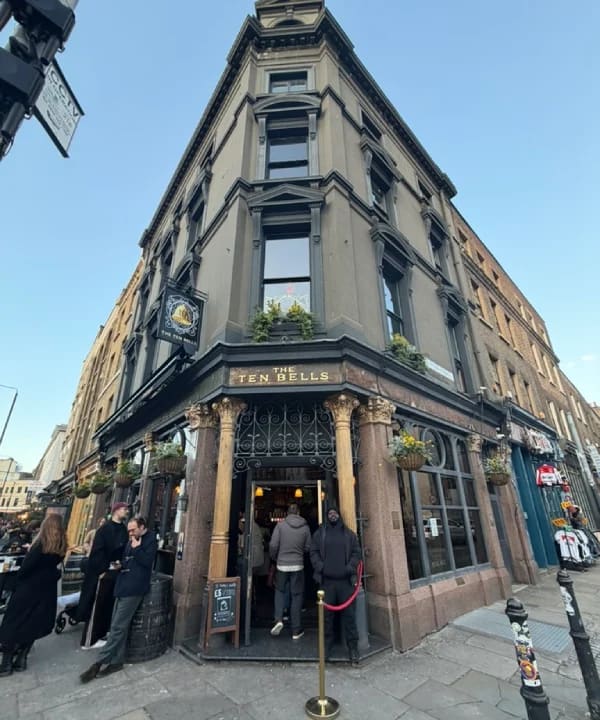
At the corner of Commercial Street and Fournier Street sits The Ten Bells, a Grade II listed pub dating in some form to the mid-eighteenth century, named for the peal of bells at the Christ Church next door. Two of the case's canonical victims, Annie Chapman and Mary Jane Kelly, are traditionally linked to drinking there in the hours before their deaths. The tiled interior is original. The pub gets busy fast after 6pm with a mix of tour groups and regulars, so arriving just after opening gives you a quieter look at the tiled interior before the room fills. Stop for one drink before continuing east.
This is also the exact ground covered by the Jack the Ripper Free Walking Tour, which runs in the evening when the streets are quieter and the case's geography is easier to follow without daytime crowds and market stalls in the way. Whichever day you slot it into, it is worth checking the current tour schedule before you land, since start times shift with the season.
Insider Tips
However you sequence this 3 days in London itinerary, buy a contactless-compatible bank card or an Oyster card on day one rather than single tickets. London's transport fares cap daily spending automatically, so tapping in and out always costs less than buying tickets one at a time, and there is no registration needed for a physical Oyster card bought from any station machine. I've queued behind visitors buying paper day tickets at a machine and watched them pay nearly double what a capped contactless tap would have cost for the same three days.
Book the Regency Cafe morning for Day 1 specifically. It closes at weekends by mid-afternoon and shuts entirely on Sundays, so if your three days include a Sunday, shift Westminster to a weekday and use the Sunday for Soho or Whitechapel instead, both of which run normal hours all week. I once turned up on a Sunday expecting a full breakfast and found the shutters down, so this is one detail worth checking before you build your morning around it.
Final London Insiders Tip
Three days moves fast, and the version of London most visitors remember afterwards is whichever neighbourhood they walked rather than rushed through. Pick one thread through each area, whether that's ceremony and history in Westminster, food and streets in Soho, or the Victorian case in Whitechapel, and let the other sights fill in around it instead of trying to tick off everything at once. On my own three-day rotations through the city, the days that stuck were always the ones where I put my phone away for an hour and just walked.
If you only do one thing to make each day easier, book a free walking tour for whichever neighbourhood you're covering that day. Having your guide handle the route and the timing means you spend your energy looking at the city instead of checking a map on a street corner, and the tours are genuinely free, with tipping at the end entirely up to you.